Introduction to Circuit Breaker Lockout Devices
Circuit breaker lockout devices are protective safety tools, primarily used to prevent the accidental or unauthorized operation of circuit breakers. A circuit breaker is a switching device capable of making, carrying, and breaking current under normal circuit conditions, and also of making, carrying, and breaking current under abnormal conditions, including short circuits, within a specified time.
Circuit breakers are widely used in factory power distribution and power management systems. During normal operation of equipment, circuit breakers are locked to prevent unauthorized shutdowns that could disrupt production. When equipment or electrical lines require maintenance, circuit breakers must also be locked out to ensure the safety of maintenance personnel.
Types of Circuit Breaker Lockout Devices
Circuit breaker lockout devices are generally divided into four types: miniature circuit breaker lockouts, large circuit breaker lockouts, universal circuit breaker lockouts, and clamp-on (horn-type) circuit breaker lockouts.
- Miniature Circuit Breaker Lockout
Made of high-strength resin, this type is easy to apply and operate. - Large Circuit Breaker Lockout
Made of high-strength resin with strong impact resistance. Stainless steel serrations enhance durability and stability. It is suitable for a wider range of circuit breakers. The unique design fits 380V/600V circuit breakers and those with handle widths of 41 mm and 15.8 mm. - Universal Circuit Breaker Lockout
Manufactured from steel, zinc, aluminum alloy, and high-strength nylon, making it durable and robust. The slide design allows for quick installation and ease of use. It can be used with either a padlock or a cable lock, representing a new generation of circuit breaker lockout devices. - Clamp-on (Horn-type) Circuit Breaker Lockout
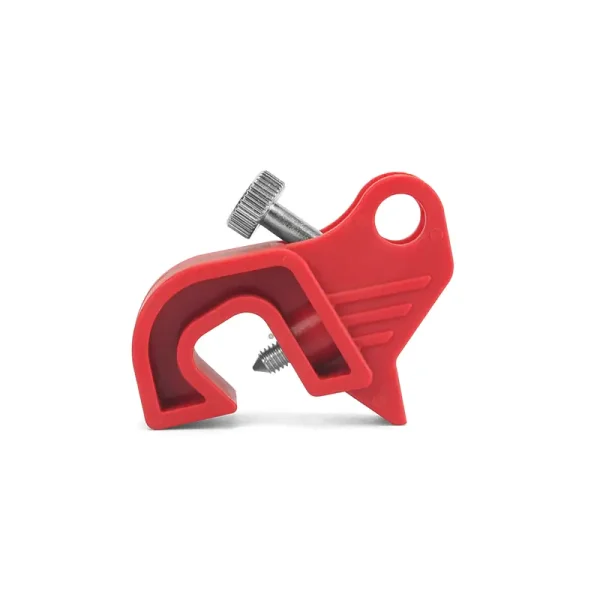
Made of high-strength resin, featuring a unique “shark-tooth” design with stainless steel fixing screws. It provides a stronger grip on the circuit breaker handle. With adjustable barriers and scale markings on both sides, it accommodates different handle travel lengths, effectively reducing looseness and improving safety.
Working Principle of Circuit Breaker Lockout Devices
A circuit breaker typically consists of a housing, internal components, and an external handle used to switch it on and off.
To prevent accidental operation during maintenance or overhaul, a lockout device is used to secure the handle in place, ensuring the breaker remains in a fixed state. A typical lockout device includes a base, a clamp, and a secondary clamp mounted on the base. A cover is hinged to the base via a rotating shaft and is used to enclose and secure the handle.
Once the handle is clamped, the cover is closed over the base and clamps. Lock holes on the cover and base align, allowing a padlock to pass through them and prevent the cover from opening. Because the device encloses the handle tightly and sits close to the breaker surface, the handle cannot be moved. Only authorized personnel with the key can unlock it, effectively preventing accidental or unauthorized operation.
Structural Adjustment and Limitations
After releasing the clamp and secondary clamp, the lockout device can be removed and the circuit breaker returns to normal operation.
To allow flexible adjustment, the base is equipped with driving components that control the movement of the clamps. Guide structures such as guide holes and guide blocks are installed on both the base and clamps to ensure smooth relative motion.
For example:
- The first clamp may be adjusted using an eccentric wheel mounted around a rotating shaft, which presses and moves the clamp along guide rails.
- The second clamp may be adjusted via an adjustment screw connected to a handwheel, which drives the clamp along another guide path.
However, in existing designs, a key drawback is that the adjustment screw must be rotated multiple times, making the movement of the second clamp relatively slow. As a result, installing the lockout device can be time-consuming.
Classification of Circuit Breaker Safety Locks
Circuit breaker safety locks are also commonly categorized into four types: miniature, large, universal, and small circuit breaker lockouts.
- Miniature type: Made of high-strength resin, easy to lock.
- Large type: Impact-resistant, with stainless steel teeth for enhanced strength.
- Universal type: Made from steel, zinc, aluminum alloy, and high-strength nylon; durable and versatile, compatible with both padlocks and cable locks.
- Small type: Features a shark-tooth design with stainless steel screws and adjustable barriers, ensuring a tighter and more secure grip.
Safety Significance and Regulations
According to investigations by professional organizations in the United States, approximately 10% of industrial accidents are related to improper use of lockout/tagout devices. Each year, about 2,500 accidents occur due to incorrect unlocking procedures, resulting in over 200 deaths and 60,000 injuries. Companies lose an average of 24 working days annually due to such incidents.
This is why the Occupational Safety and Health Administration (OSHA) issued the Hazardous Energy Control (Lockout/Tagout) standard on September 1, 1989. The regulation requires that all energy sources be properly locked and tagged during equipment maintenance in industrial environments to prevent accidental release of hazardous energy.
Core Function of Circuit Breaker Safety Lockouts
The primary function of circuit breaker lockout devices is to isolate and secure energy sources, enabling operators to effectively control energy release during maintenance. This significantly reduces the risk of accidents and ensures the safety of personnel.


Comments
Post a Comment