Instructions for Using Cable Lockout Devices
Safety cable lockout devices are commonly used in conjunction with various safety ropes. They can effectively control the sliding speed of the safety rope, ensuring that users do not fall from heights and get injured. So, what are the functions of safety cable lockout devices? Next, I will briefly introduce this practical knowledge.
How to Use Safety Cable Lockout Devices:
- Rope operation: Hold the rope between the building and the body with the left (or right) hand, and hold the handwheel and tensioning device with the right (or left) hand. When the user leans backward, as the safety rope is gradually released, the handwheel loosens; when tightening, the rope remains in a locked state.
- Shortening the safety rope: Pull the free end of the rope on the other side of the retractor with the right (or left) hand. The user can adjust position relative to the building accordingly.
- During use and management, the rope joint and the reducer joint should be connected to the side ring of the harness.
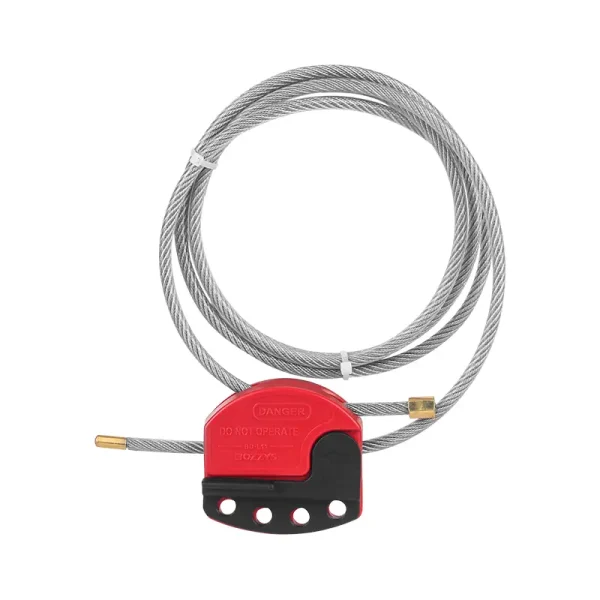
Safety Cable Lock
Precautions for Steel Wire Rope Safety Lock:
- The main rope must be selected correctly; mixing different types is strictly prohibited.
- The self-locking device must be properly installed on the upper roller (protruding part).
- Before installation, remove the safety screw. Rotate the ratchet shaft counterclockwise to withdraw the ratchet assembly roller. After loading the main rope, rotate clockwise to secure it. Then replace the safety pin and tighten the screw (do not overtighten).
- After installing the main rope, check the flexibility of the self-locking device. If the movement is not smooth, adjust the spring appropriately. Test the locking function 1–3 times to ensure proper operation. If any abnormality is found, stop use immediately. Unauthorized modification or disassembly of the equipment is strictly prohibited.
Mechanical equipment can be used for short-term protection during maintenance or repair, or for long-term locking of gate valves and isolation switches. During maintenance operations, up to four padlocks can be used, each belonging to a different maintenance worker. The cable lock can only be removed after all workers have completed their tasks and removed their own locks, after which the valve (or isolation switch power supply) can be operated.


Comments
Post a Comment